London Heathrow Departures Grounded as ATC Technical Failure Disrupts UK Airspace
London City Airspace
London Heathrow Airport is experiencing a significant disruption on Tuesday after a technical failure affecting air traffic control equipment forced the temporary suspension of departures and later contributed to widespread restrictions across UK airspace.
The initial departure ground stop at Heathrow took effect at 12:48 p.m. local time (11:48 UTC) after an unexpected technical issue affected ATC equipment and data processing. Airport operations were subsequently subject to significant restrictions as technical teams worked to restore normal service.
The disruption came after a separate incident earlier in the day had already affected Heathrow operations.
Bird strike temporarily closes the runway
At 11:07 a.m. local time, arrivals on Heathrow's Runway 27R were temporarily suspended following a bird strike. Controllers redirected active arrival traffic to Runway 27L while ground teams cleared and inspected the affected runway. Runway 27R was reopened just six minutes later, at 11:13 a.m. The short-lived runway closure caused some operational disruption, but the situation escalated later in the afternoon when the ATC technical issue affected the wider operation.
Heathrow departures suspended
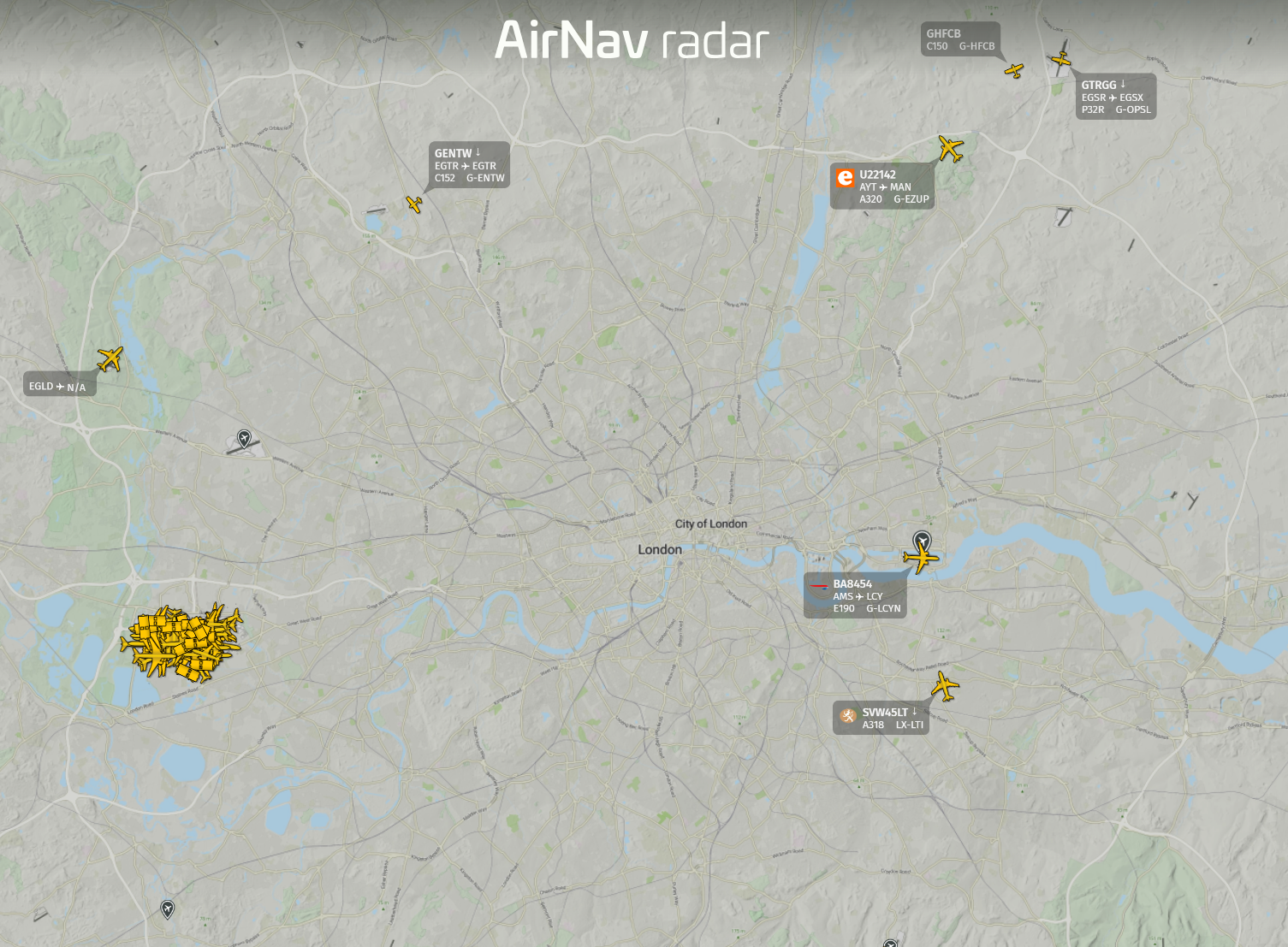
At 12:48 p.m. local time, all departing flights at Heathrow were temporarily grounded. Aircraft were seen waiting on taxiways while passengers faced delays inside the terminals. The disruption was compounded by existing operational issues related to ATC equipment, weather/turbulence, and airspace management.
Passengers were advised to check directly with their airlines before traveling to the airport, with significant knock-on delays expected throughout the afternoon and evening.
Departures gradually resume
Operations began to recover later in the afternoon.
An Aegean Airlines A3601 flight to Athens was observed waiting on Runway 27L before eventually crossing the runway to continue toward Terminal 4.
Shortly afterward, departures at Heathrow resumed. American Airlines flight AA55 to Chicago was among the first flights observed departing, at approximately 1:35 p.m. local time.
Heathrow was subsequently authorized to restart departures on CPT and DET, although high calculated take-off times were expected to remain in place until approximately 17:00 UTC.
Operations at London Gatwick also began to resume.
Second and wider ATC disruption
The situation later escalated significantly.
At 15:55 BST, Heathrow reported that all flight operations had again been stopped because of ATC equipment and data-processing issues. The airport was listed as unavailable for arrivals between 14:00 and 16:00 UTC.
By 16:23 BST, flights bound for Heathrow were reported to be holding or diverting as the restrictions continued.
At 16:49 BST, the disruption was confirmed to be affecting a much wider area. Due to faulty ATC equipment at the Swanwick control centre, the entire EGTT airspace was operating at a reduced rate.
A number of airports across Europe were subsequently requested to provide diversion capabilities, including:
-
Brussels National (EBBR)
-
Oostende (EBOS)
-
Frankfurt (EDDF)
-
Cologne/Bonn (EDDK)
-
Düsseldorf (EDDL)
-
Munich (EDDM)
-
Manchester (EGCC)
-
Amsterdam Schiphol (EHAM)
-
Eindhoven (EHEH)
-
Dublin (EIDW)
-
Copenhagen/Kastrup (EKCH)
-
Paris Charles de Gaulle (LFPG)
The development meant that the disruption was no longer limited to Heathrow, with reduced capacity affecting traffic across a significant portion of UK airspace.
Impact across the UK
The technical issue also affected other airports. Liverpool, John Lennon, Birmingham, Manchester, Bristol, East Midlands, Southampton, Glasgow, and Belfast all issued warnings about disruption, with departures particularly affected.
Bristol Airport said arriving flights were not initially affected, while Birmingham warned that the issue was affecting a significant number of departing flights across the country. Ryanair said that more than 50 flights had been canceled and that more than 65,000 passengers had been delayed by up to 8 hours due to the technical issue.
Flight disruptions continue across major London airports, with 2,000 cancellations recorded between yesterday and today (September 9). London Heathrow (LHR) remains the most affected, with 362 flights canceled yesterday and a further 165 today, while delays reached 425 yesterday and 1 today. At London Gatwick (LGW), 229 flights were canceled yesterday and 29 today, with 308 delays yesterday and 4 today. London Stansted (STN) recorded 114 cancellations yesterday and 8 today, alongside 279 delays yesterday and 16 today. The figures highlight the continued impact of the air traffic disruption on passengers and operations across London’s major airports.
Disruptions are also affecting other major airports across the UK. London Luton (LTN) has recorded 70 cancellations and 136 delays, while Manchester Airport (MAN) has reported 45 canceled flights and 317 delays, according to AirNav Radar data.
The incident demonstrates how a technical problem at a key air traffic control facility can rapidly affect flight operations far beyond a single airport, triggering capacity restrictions, delays, holding patterns and diversions across the wider European network.