NTSB makes ‘urgent safety recommendations’ after Potomac Crash
On March 11, 2025, the National Transportation Safety Board (NTSB) released a preliminary report shedding light on the events leading to the tragic mid-air collision over the Potomac River near Washington, D.C., involving a U.S. Army Sikorsky UH-60L Black Hawk helicopter and a Bombardier CRJ700 regional jet, operating as PSA Airlines Flight AA5342. The accident, which resulted in the loss of all 67 lives aboard both aircraft, has become one of the deadliest aviation incidents in recent U.S. history.
Mid-Air Collision Near Washington, D.C.: PSA Airlines CRJ-700 and Sikorsky UH-60 Black Hawk
The NTSB's investigation has uncovered a concerning sequence of events that began at approximately 8:33 PM EST on January 29, 2025. The Black Hawk, operating under the radio callsign PAT25, requested clearance to navigate helicopter Routes 1 and 4 en route to Davison Army Airfield (DAA) at Fort Belvoir, Virginia. At the same time, PSA Airlines Flight 5342, a scheduled domestic passenger flight from Wichita Dwight D. Eisenhower National Airport (ICT) to Ronald Reagan Washington National Airport (DCA), was on the Mount Vernon visual approach to runway 1.
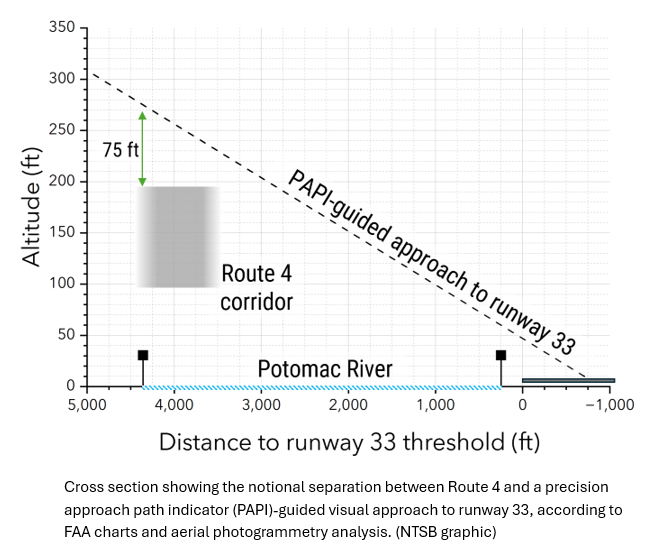
The tragic collision occurred at 8:47:59 PM, at an altitude of around 300 feet, as Flight AA5342 was on its final approach to runway 33. The collision, which was filmed from various perspectives, unfolded when both aircraft were nearby yet operating on different radio frequencies, preventing the crews from hearing each other's transmissions.
NTSB’s Urgent Safety Recommendations
In response to this devastating incident, the Federal Aviation Administration (FAA) issued a Notice to Airmen (NOTAM) on February 19, 2025, restricting helicopter traffic near DCA until March 31, 2025, to prevent further incidents. In its report, the NTSB has made urgent safety recommendations to the FAA to prevent similar tragedies in the future. These recommendations include:
- Assessing Helicopter Route 4: Evaluate the interaction between helicopters and fixed-wing traffic, particularly around DCA's runway 33 arrivals and runway 15 departures.
- Establishing Safe Separation Procedures: Develop new procedures to ensure safe separation, such as redesigning helicopter routes or holding patterns when certain runways are used.
- Prohibiting Operations on Route 4 Between Hains Point and Wilson Bridge: To prevent proximity conflicts, this area should be off-limits for helicopter traffic when runways 15 and 33 are used.
- Designating Alternative Helicopter Routes: When Route 4 is closed, routes that bypass the restricted area will be established, ensuring safer navigation for helicopters near DCA.
Long History of Near-Misses at DCA
The NTSB's preliminary findings also revealed a troubling history of near-miss incidents at Ronald Reagan Washington National Airport. Between 2011 and 2024, there were numerous reports of close encounters between helicopters and commercial aircraft, particularly during approaches to landing. Data from the FAA and voluntary safety reporting programs revealed that many of these incidents triggered TCAS (Traffic Collision Avoidance System) alerts, many involving helicopters operating above the altitude restrictions.
In the review of commercial operations at DCA between October 2021 and December 2024, over 15,000 instances occurred where commercial aircraft and helicopters came dangerously close, with a lateral separation distance of less than 1 nautical mile and vertical separation of less than 400 feet. The data also showed frequent TCAS alerts and violations of helicopter altitude restrictions, with over half of these occurrences occurring at night, further increasing the risk of collisions.