Follow the 2026 Total Solar Eclipse Live with AirNav Radar
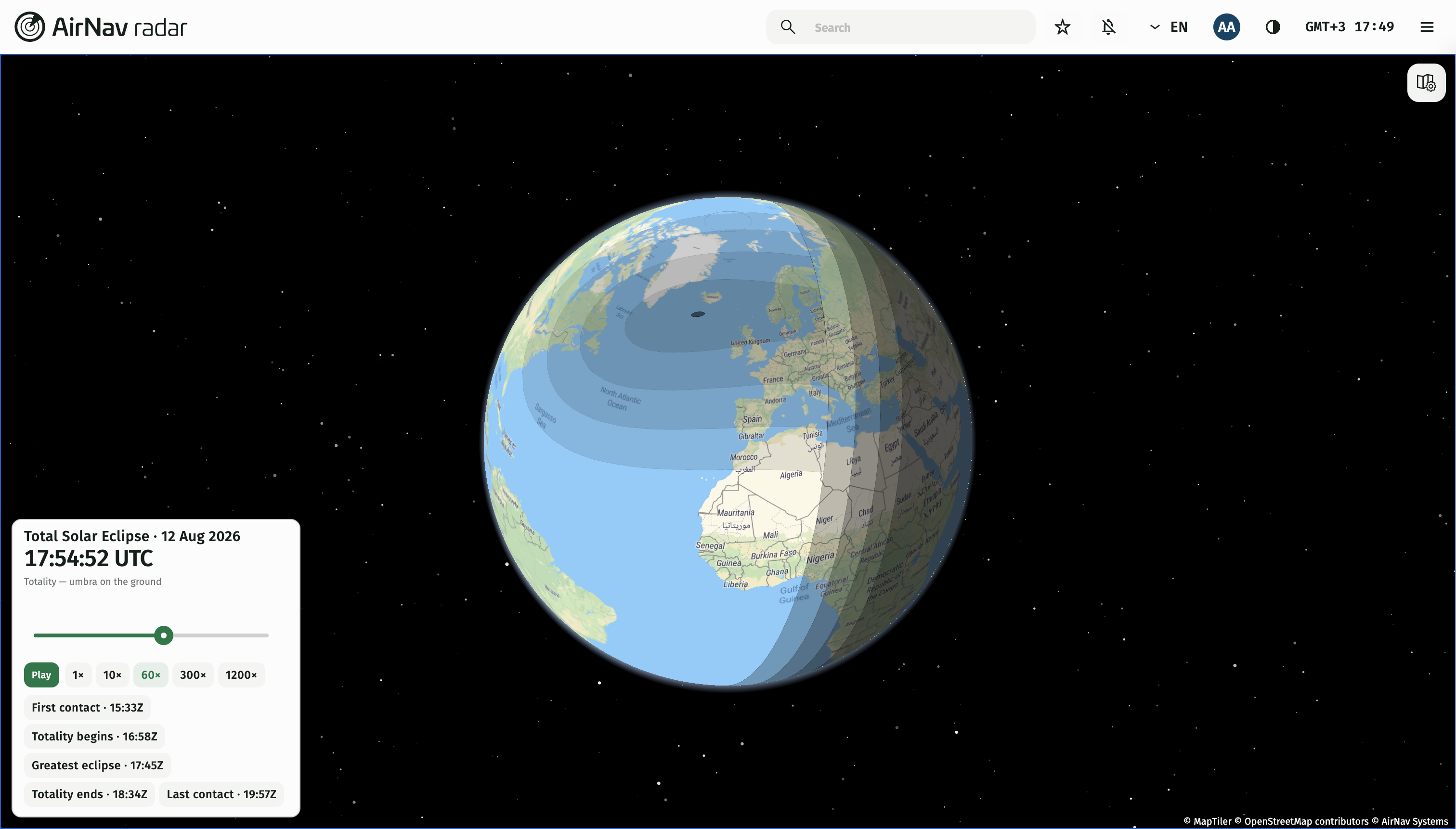
On Wednesday, August 12, a total solar eclipse will cross parts of Spain and Portugal, as the Moon passes directly between the Earth and the Sun, casting its shadow across the Iberian Peninsula. While northern Spain and a small area of northeastern Portugal will experience totality, much of the rest of the two countries will see a partial eclipse.
Starting at 15:00 UTC on August 12, you’ll be able to follow the eclipse directly on AirNavRadar.com, combining the movement of the Moon’s shadow with real-time flight tracking in a completely new way.
Follow the Eclipse on AirNav Radar
The new eclipse experience will be available on AirNavRadar.com from 15:00 UTC, giving aviation and astronomy enthusiasts a chance to watch the event unfold across the globe.
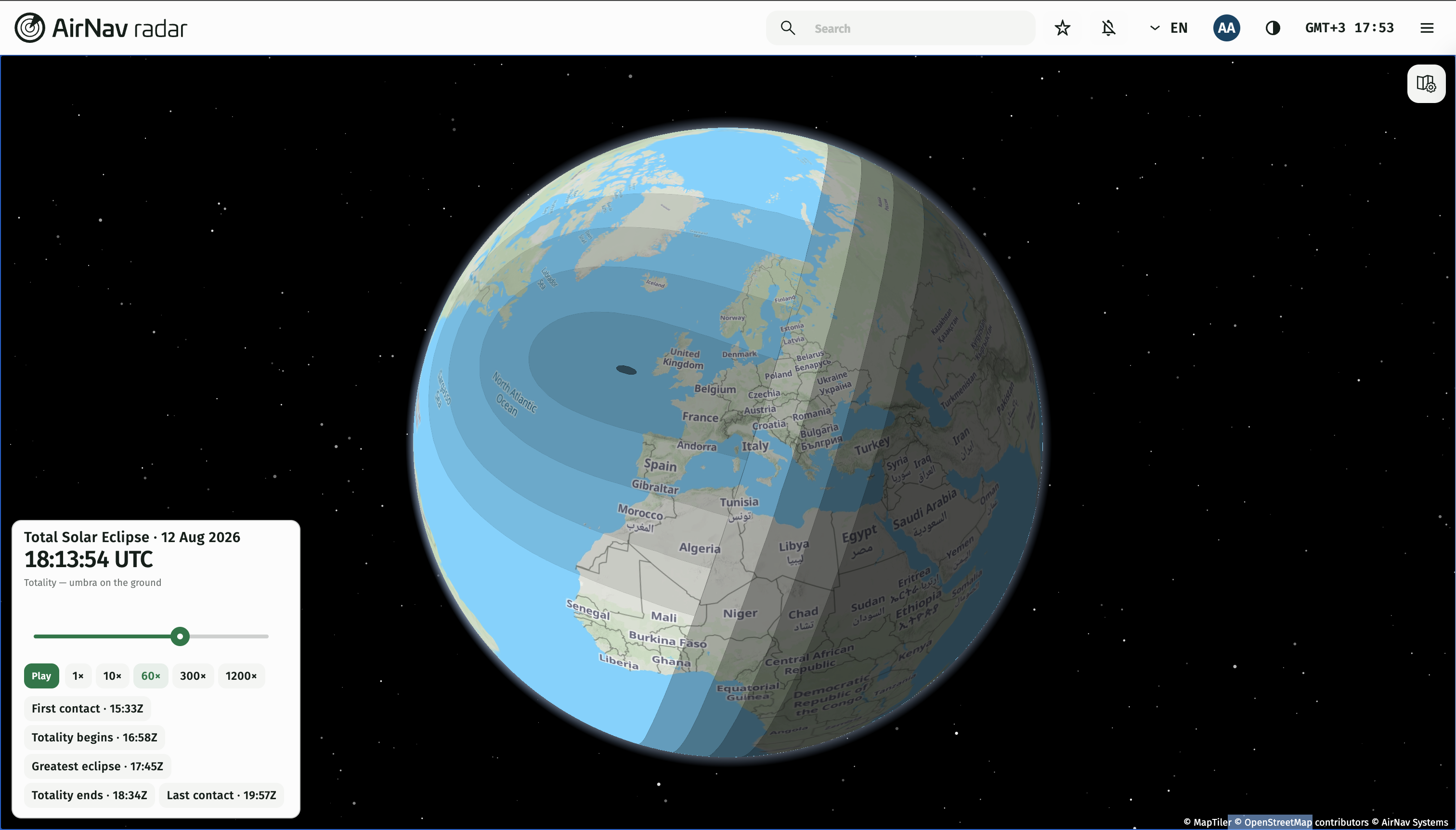
As the Moon passes between the Earth and the Sun, its shadow will travel across the Arctic, Iceland, the Iberian Peninsula and beyond. With AirNav Radar, you can explore the event while following aircraft operating in and around the eclipse path.
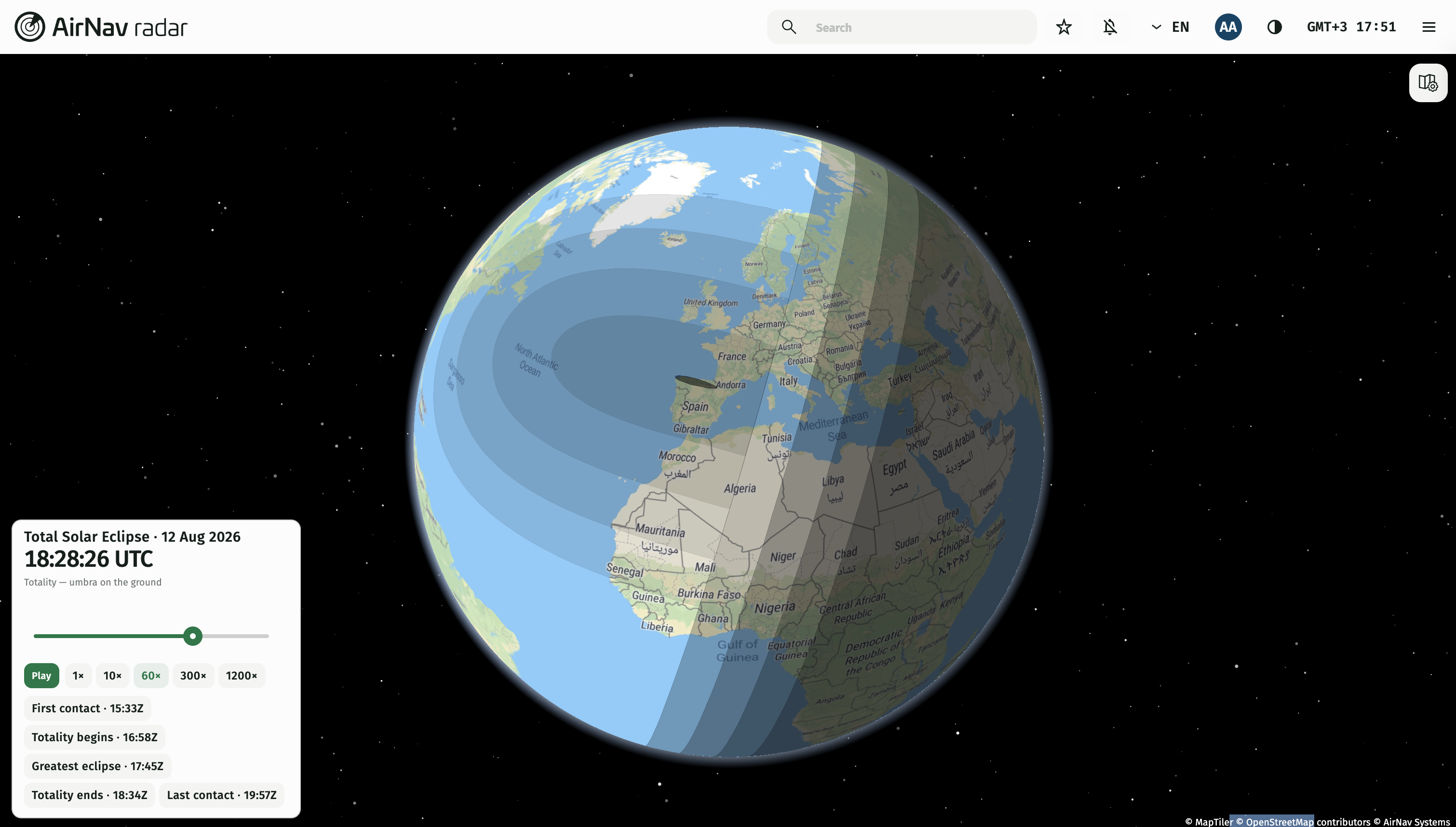
Open AirNavRadar.com Website from 15:00 (04:00 PM) UTC on August 12, 2026 and follow the eclipse live.
Where will the eclipse be visible?
The totality of the eclipse will occur at different times along its path: in Greenland, approximately between 16:12 and 16:40 WGST; in Iceland, around 17:48 local time in Reykjavík; in Spain, approximately between 20:26 and 20:33 CEST in areas along the path; in Portugal, around 19:30 WEST in the small area reaching totality; and in Russia, at different times across the country’s extensive eclipse path.
The eclipse begins and ends at different times depending on the exact location. For example, in Spain, totality begins around 20:26 CEST and ends around 20:33 CEST along the national path, while Madrid experiences totality at approximately 20:30–20:32 CEST. In Iceland, Reykjavík is expected to experience totality at approximately 17:48 local time (15:48 UTC).
Portugal will see only a very small section of the path of totality, while much of the country will experience a partial eclipse.
Iberia’s A321XLR will fly into the eclipse
One of the most unusual flights connected to the event will be Iberia IB1473, operated by an Airbus A321XLR. The aircraft will depart Madrid and return to Madrid, following a specially planned route over northern Spain. Flying at more than 33,000 feet, the aircraft will position itself to give researchers and guests on board an exceptional view of totality.
The high altitude will place the aircraft above clouds and much of the lower atmosphere that can interfere with observations from the ground. This is especially important because the eclipse will occur close to sunset over Spain, when the Sun will already be low on the horizon.
A flying observatory
IB1473 will serve as an airborne observatory for researchers from the Shelios project, led by astronomer Miquel Serra-Ricart, scientific director of Light Bridges and researcher at the Instituto de Astrofísica de Canarias.
Researchers will use the flight to study the Sun’s morphology and its corona — the faint outer atmosphere that becomes visible during totality when the Moon completely covers the bright solar disc.
Iberia also plans to use the high-speed Starlink connectivity being introduced across its fleet to broadcast live images from the aircraft through its social media channels.
Track IB1473 with AirNav Radar

Photographer: Bastian Ding - AirTeamImages.com
The special Iberia flight can be identified by its flight number:
Track it by clicking here
As the Moon’s shadow moves across the planet, AirNav Radar will let you follow the event alongside global aviation activity, giving you a unique perspective on the relationship between the skies above and the celestial event unfolding below.